What Does PLC Stand For? Meanings, Uses & Examples
PLC stands for Programmable Logic Controller. In industrial automation, a PLC is a rugged computer that controls machines, equipment, and manufacturing processes.
However, PLC can have several meanings. In British business English, PLC also stands for Public Limited Company. Other uses include Power Line Communication and Professional Learning Community.
PLC Meanings at a Glance
| PLC Meaning | Field | What It Means |
| Programmable Logic Controller | Industrial automation | A computer used to control machines and processes |
| Public Limited Company | Business | A company structure used mainly in the UK and some other countries |
| Power Line Communication | Technology | Sending data through electrical power lines |
| Professional Learning Community | Education | A group of educators who work together to improve learning |
The correct meaning depends on the sentence or field where you see PLC. For example, a factory engineer usually means Programmable Logic Controller, while a UK company name ending in “plc” means Public Limited Company.
What Does PLC Stand For in Technology?
In technology and industrial automation, PLC stands for Programmable Logic Controller.
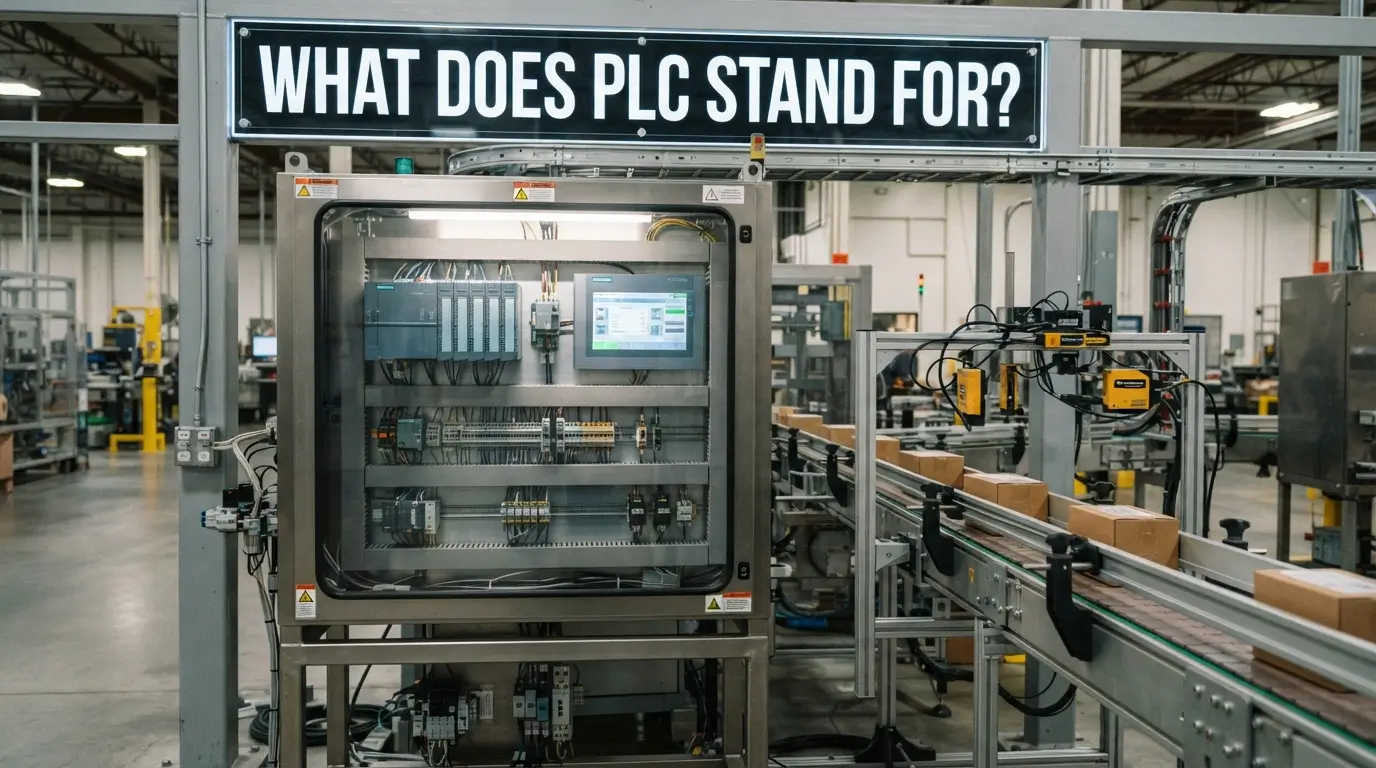
A PLC is a special type of industrial computer. It reads information from inputs such as sensors and switches. It then follows programmed instructions and controls outputs such as motors, valves, lights, and alarms.
PLCs are designed for industrial environments. They can operate around vibration, electrical noise, dust, temperature changes, and other conditions that may be difficult for ordinary computers.
What Does Each Letter in PLC Mean?
P = Programmable
The controller can be programmed and reprogrammed for different control tasks.
L = Logic
The controller uses programmed rules to make decisions from input conditions.
C = Controller
The device controls equipment by changing its outputs based on those decisions.
So, a Programmable Logic Controller describes a device that uses programmable instructions to control machines and processes.
What Is a PLC?
A PLC is an industrial control computer used to automate machinery and processes.
A simple PLC system has three main parts:
- Inputs — receive information from sensors, switches, and other devices.
- CPU and program — process the inputs and make control decisions.
- Outputs — send commands to devices such as motors, valves, and alarms.
For example, imagine a conveyor belt in a factory. A sensor detects a product. The PLC receives that signal and checks its programmed instructions. It can then start, stop, or change the conveyor based on those instructions.
How Does a PLC Work?
A PLC normally works through a repeating control cycle.
It first reads its input signals. Next, it executes the programmed logic. Finally, it updates its outputs. This cycle repeats continuously while the controller operates.
A simple example looks like this:
Sensor detects product → PLC reads sensor → PLC runs logic → Motor starts
This lets machines respond automatically without a person controlling every step.
Where Are PLCs Used?
PLCs are common in industrial automation.
You may find them controlling:
- Conveyor systems
- Packaging machines
- Assembly lines
- Pumps
- Motors
- Robotic equipment
- Food-processing machines
- Water and wastewater systems
- Energy equipment
- Manufacturing machinery
Rockwell Automation describes PLCs as industrial computers designed for manufacturing processes, machinery, and robotic systems.
PLCs can also communicate with other industrial systems. These may include HMI, SCADA, manufacturing systems, and industrial networks.
What Programming Languages Do PLCs Use?
PLC programming is covered by the IEC 61131-3 standard.
The current IEC 61131-3:2025 standard specifies programming languages and related elements for programmable controllers. These include:
- Ladder Diagram (LD)
- Structured Text (ST)
- Function Block Diagram (FBD)
- Sequential Function Chart (SFC)
The 2025 edition also includes changes from the earlier 2013 version.
Ladder Diagram is especially familiar in PLC work because its visual structure resembles traditional relay-control diagrams.
A Short History of PLCs
PLCs grew from the need to replace large systems of hardwired relay controls.
Changing a relay-based machine often required physical wiring changes. A programmable controller allowed control logic to be changed through programming instead. This made automated systems easier to modify and expand.
Rockwell Automation’s history records Allen-Bradley pioneering the programmable logic controller in 1970. Its history also records the shipment of its one-millionth PLC in 1995.
Simple PLC Timeline
Early relay control → Programmable controllers → Modern PLC systems → Connected industrial automation
The technology has continued to evolve rather than becoming a fixed, outdated standard.
What Is New With PLC Standards?
PLC technology is still actively standardized.
The IEC 61131-3:2025 edition was published on May 22, 2025. It updated the international standard for programmable-controller programming languages.
More recently, the IEC published the IEC 61131 series collection on July 10, 2026. The collection brings together the different parts of the programmable-controller standard family.
This shows that PLC technology continues to have an active role in modern industrial automation.
What Does PLC Stand for in Business?
In British business English, PLC stands for Public Limited Company.
A public limited company is a company whose shares can be bought and sold by the public. The abbreviation plc is normally placed after the company’s name.
For example:
Example Company plc
Here, plc does not refer to industrial automation. It identifies a company type.
PLC vs. Ltd.
A plc and Ltd are different company designations in UK business terminology.
A public limited company can offer its shares to the public, while a private limited company does not offer its shares to the public in the same way.
So, if you see PLC after a company’s name, the business meaning is usually the intended one.
Other Meanings of PLC
PLC is also used in several other fields.
Power Line Communication
In communications and electrical technology, PLC can mean Power Line Communication.
This refers to using electrical power lines to carry communication signals.
The meaning is different from a Programmable Logic Controller. The surrounding technical context tells you which meaning applies.
Professional Learning Community
In education, PLC can mean Professional Learning Community.
It describes educators working together to improve teaching and student learning. This use is common in education discussions and professional development.
Phospholipase C
In biology and medicine, PLC can also stand for Phospholipase C.
This is a type of enzyme. Therefore, a medical or biology text may use PLC in a completely different way from an engineering document.
The abbreviation also has several specialized meanings in science, business, education, and technology.
PLC: Acronym or Initialism?
PLC is an initialism, not a traditional spoken acronym.
An acronym is normally pronounced as a word, such as NASA.
PLC is usually pronounced by saying each letter separately:
P-L-C
Oxford gives the pronunciation as /ˌpiː el ˈsiː/.
The same letter-by-letter pronunciation applies to the common business meaning, Public Limited Company.
Myth vs. Fact
Myth: PLC always means Programmable Logic Controller.
Fact: PLC has several meanings. The correct meaning depends on context.
Myth: PLC is only used in factories.
Fact: Programmable Logic Controllers are strongly associated with industrial automation, but PLC can also mean terms used in business, education, communications, and science.
Myth: PLC is pronounced like one word.
Fact: PLC is normally pronounced by saying its three letters: P-L-C.
PLC Used in a Sentence
Here are natural examples using the main meanings:
- The engineer programmed the PLC to control the conveyor belt.
- The factory installed a new PLC for its packaging system.
- The company changed its legal name to include “plc.”
- The teachers joined a PLC to discuss classroom strategies.
Notice how the surrounding words reveal the meaning.
Words such as sensor, motor, machine, and automation usually point to Programmable Logic Controller.
Words such as company, shares, investors, and business usually point to Public Limited Company.
How Is PLC Pronounced?
PLC is pronounced “P-L-C.”
You say each letter separately:
pee — el — see
The pronunciation is the same whether PLC means Programmable Logic Controller or Public Limited Company.
PLC vs. PAC: What’s the Difference?
PLC means Programmable Logic Controller.
PAC means Programmable Automation Controller.
Both are used for industrial automation. The terms can overlap, but PAC systems are often positioned for broader or more complex automation tasks. Rockwell Automation describes PACs as systems suited to plant-wide control, including motion control, process control, and data acquisition.
The exact distinction can vary between manufacturers and automation systems.
Frequently Asked Questions
What does PLC stand for in simple terms?
PLC usually stands for Programmable Logic Controller. It is an industrial computer that follows programmed instructions to control machines and automated processes.
What is the main purpose of a PLC?
The main purpose of a PLC is to monitor inputs, process programmed logic, and control outputs. This allows machines and industrial processes to operate automatically.
Is PLC the same as a computer?
A PLC is a type of computer-based controller, but it is built specifically for industrial control. It is designed for reliable operation in industrial environments and works with industrial inputs and outputs.
What does PLC stand for in education?
In education, PLC commonly stands for Professional Learning Community. It refers to educators working together to improve teaching and learning.
What does PLC mean after a company name?
When plc appears after a company name in British business English, it means Public Limited Company. It identifies a type of company whose shares can be bought and sold by the public.
Conclusion
PLC most commonly stands for Programmable Logic Controller in industrial and engineering contexts. It is a programmable industrial computer used to control machines and automated processes.
In business, especially in British English, PLC can mean Public Limited Company. Other meanings exist, so the surrounding context is important when deciding what PLC means.

Emily Morgan is a language and communication writer who specializes in explaining abbreviations, internet terms, workplace language, and common expressions. Her writing turns unfamiliar terms into clear definitions that are easy for students, professionals, and everyday readers to understand.