What Does Bible Stand For? Meaning, Origin, and Common Acronyms
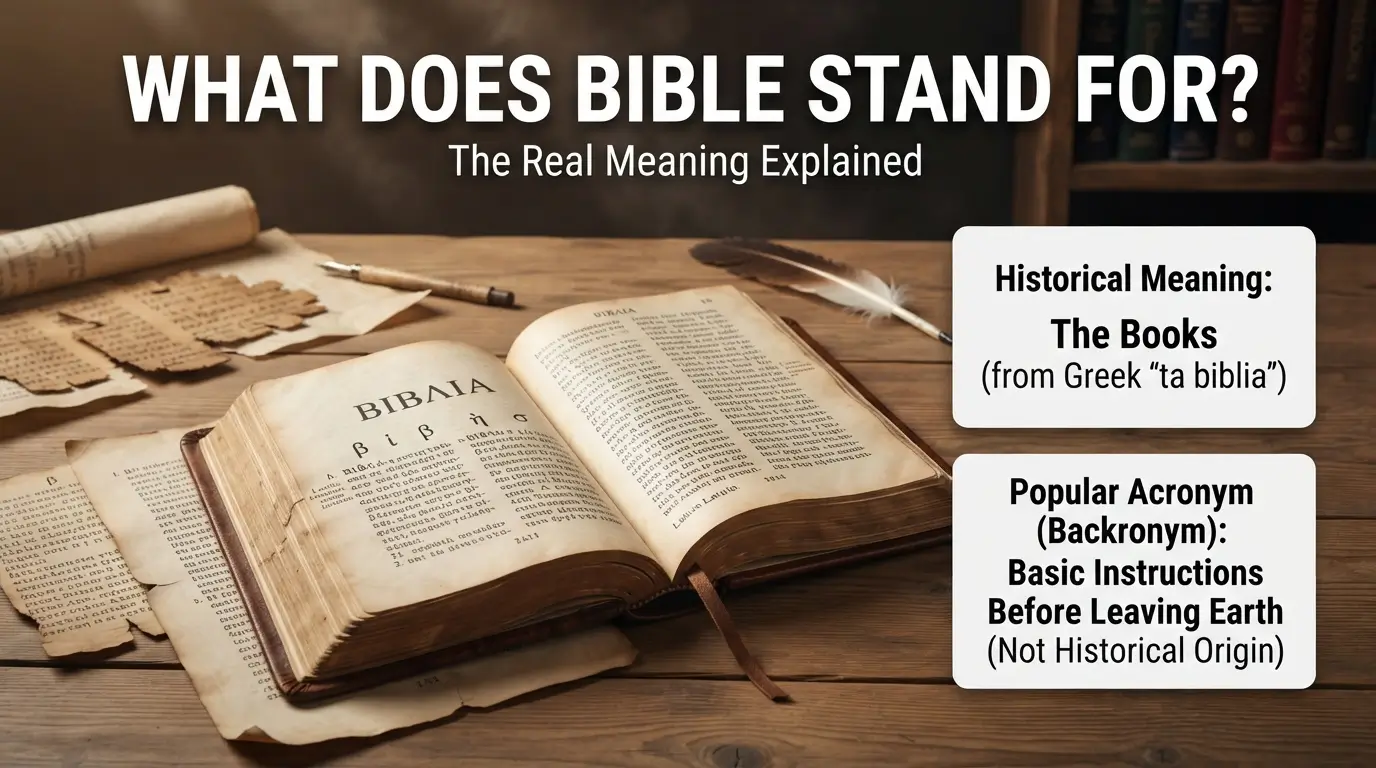
Bible stands for “books,” but it is not actually an acronym. The word comes from the Greek ta biblia, meaning “the books.”
Unlike words such as NASA or SCUBA, the letters in B-I-B-L-E do not each represent another word. Several phrases, such as “Basic Instructions Before Leaving Earth,” are popular backronyms. They are later wordplays, not the historical origin of the word Bible.
Quick Reference: Bible Meaning
| Detail | Answer |
| Word | Bible |
| Does it stand for an acronym? | No |
| Basic meaning | “Books” |
| Greek form | ta biblia |
| Language of origin | Ancient Greek |
| Category | Religious term / name for sacred writings |
| Main Christian divisions | Old Testament and New Testament |
| Common popular acronym | “Basic Instructions Before Leaving Earth” |
| Historical status of that acronym | Backronym, not the word’s origin |
The Greek phrase ta biblia means “the books.” The term developed into the name used for the collection of Christian sacred writings.
What Is the Bible?
The Bible is a collection of sacred writings used in Christianity. It is not one book written by one person at one time. It contains different types of writing, including history, poetry, wisdom, prophecy, laws, stories, and letters.
For Christians, the Bible is commonly divided into two main sections:
- Old Testament
- New Testament
The Old Testament contains writings that form the Scriptures of ancient Israel. The New Testament contains writings about Jesus, his teachings, his followers, and the early Christian church.
Different Christian traditions can have different biblical canons. This means they may recognize different sets of books as part of the Bible.
Where Does the Word “Bible” Come From?
The word Bible comes through Latin and other European languages from Greek terms related to biblion and biblia. The Greek ta biblia means “the books.”
The Greek word biblion could refer to a book, scroll, or written document. It is connected with biblos, a word associated with papyrus and writing material.
Over time, biblia came to be understood as a singular name for the collection of sacred books. This helps explain why English uses Bible as the name of one collection, even though the word has a plural history.
A Simple Timeline
Greek biblos → biblion → ta biblia (“the books”) → Latin biblia → English “Bible”
This is a word-history path, not an acronym expansion.
Is Bible an Acronym?
No. Bible is not an acronym.
An acronym is normally formed from the initial letters of a group of words. For example, NASA comes from National Aeronautics and Space Administration.
The word Bible did not form this way. Its history comes from Greek and Latin words connected with books and sacred writings.
So the following explanation is historically incorrect:
BIBLE = Basic Instructions Before Leaving Earth
This phrase may be used as a memorable Christian saying, but it did not create the word Bible. Acronym reference sites list it as a popular alternative meaning, while historical sources trace Bible to biblia.
What Does “Basic Instructions Before Leaving Earth” Mean?
“Basic Instructions Before Leaving Earth” is a popular backronym for BIBLE.
A backronym is a phrase created to fit an existing word or name. It is different from a true acronym because the original word did not come from those words.
The phrase is often used to describe the Bible as a source of guidance for life. It can be meaningful as a Christian teaching phrase, but it should not be presented as the historical meaning of the word Bible.
Other versions also appear online, including phrases such as “Basic Instructions Before Life Ends.” These are variations on the same idea rather than historical expansions of Bible.
Bible: Acronym, Initialism, or Backronym?
The best classification is simple:
Bible is neither a true acronym nor an initialism.
It is a word with an ancient linguistic history.
The popular phrase “Basic Instructions Before Leaving Earth” is a backronym. It uses the letters in an existing word to create a new phrase afterward.
Bible vs. NASA
| Word | Type | Meaning |
| Bible | Ordinary word with Greek and Latin roots | “Books” |
| NASA | Acronym | National Aeronautics and Space Administration |
| BIBLE as “Basic Instructions Before Leaving Earth” | Backronym | A later phrase built from the letters |
This difference matters because a phrase can explain an idea associated with a word without explaining the word’s actual origin.
Why Is the Bible Called the Bible?
The Bible is called the Bible because the name developed from Greek “the books.” Early Christians used biblia for the collection of sacred writings.
The name fits the nature of the Bible because it is a collection of many individual writings rather than a single continuous work.
Bible Gateway’s current Bible reference explains that the Bible is an ancient collection or library of sacred writings. Its books include different literary forms and were produced across many centuries.
How Many Books Are in the Bible?
The number of books depends on the Christian tradition and canon being discussed.
Many Protestant Bibles contain 66 books. Some other Christian traditions include additional books in their Old Testament collections.
This is one reason it is better to describe the Bible as a collection or library of sacred writings rather than assuming every Christian tradition uses exactly the same list.
For example, Biblica describes the Bible in its Christian context as a collection of 66 books, while also noting its wide range of writing styles.
What Are the Old and New Testaments?
The Old Testament and New Testament are the two major sections of the Christian Bible.
The Old Testament contains writings that form the Scriptures of ancient Israel. The New Testament contains writings centered on Jesus Christ and the early Christian movement.
The exact number and arrangement of books can differ between Christian traditions.
Is the Bible One Book or Many Books?
The Bible is commonly treated as one book, but it is also a collection of many books.
Its individual writings have different authors, styles, settings, and purposes. These include narrative, poetry, wisdom literature, prophecy, law, and letters.
This is also reflected in the original meaning of the word. The Greek ta biblia literally means “the books.”
Common Myths About What Bible Stands For
Myth 1: Bible officially stands for “Basic Instructions Before Leaving Earth”
Fact: This is a popular backronym, not the historical origin of the word Bible. The word traces to Greek ta biblia, meaning “the books.”
Myth 2: Each letter in BIBLE has an original biblical meaning
Fact: No longer English phrase created the letters B-I-B-L-E. The word developed from older Greek and Latin terms.
Myth 3: “Bible” simply means one book
Fact: The word has a plural origin connected with “books.” The Bible is a collection of individual sacred writings.
What Does Bible Mean in Greek?
The Greek expression ta biblia means “the books.” The singular-related word biblion could refer to a book or scroll.
The word also links to biblos, which means papyrus or writing material. Over time, related Greek terms became associated with written books and collections of writings.
How Is “Bible” Pronounced?
Bible is pronounced:
BY-buhl
/ˈbaɪbəl/
The first part sounds like “buy.” The second part has a short, unstressed sound.
The plural form is Bibles, pronounced BY-buhlz.
What Does the Bible Represent?
For Christians, the Bible is sacred Scripture and a central source of teaching about God, humanity, faith, and Christian life.
Different Christian traditions and readers understand particular passages in different ways. Still, Christians widely treat the Bible as a foundational collection of sacred writings.
The Bible includes many kinds of writing. These include stories, songs, prayers, laws, wisdom sayings, prophetic writings, and letters.
Is “Basic Instructions Before Leaving Earth” Wrong?
It depends on what you mean by wrong.
As a historical definition of the word Bible, it is incorrect. The word did not originate from those five English words.
Christians can use it as a memorable mnemonic or teaching phrase to describe how someone views the Bible. Acronym reference sources list this phrase as a popular meaning.
The key distinction is between word origin and later wordplay.
What Does the Bible Stand For in Christianity?
Christians treat the Bible as sacred Scripture and an important source of teaching about God and faith.
Its content covers many themes, including creation, covenant, worship, morality, wisdom, human failure, redemption, Jesus Christ, and the early Christian church.
The precise theological understanding can differ among Christian denominations.
Current Understanding of the Bible
The Bible remains a major subject of study, translation, teaching, and discussion. A Bible Gateway guide published in September 2026 continues to address questions about its authors, structure, translations, history, and meaning.
Modern Bible resources also continue to explain why the Bible contains different books, why translations vary, and why different Christian traditions can have different canons.
This current interest shows that the question “What does Bible stand for?” can have two different meanings. Someone may be asking about the word’s origin or about what the Bible represents in Christian faith.
People Also Ask
Does Bible stand for Basic Instructions Before Leaving Earth?
No. “Basic Instructions Before Leaving Earth” is a popular backronym. The historical word Bible comes from Greek ta biblia, meaning “the books.”
Is Bible an acronym?
No. Bible is not an acronym. It developed from Greek and Latin words related to books and sacred writings.
What does the word Bible mean?
The word Bible comes from Greek ta biblia, meaning “the books.” It became the name for the collection of sacred writings used by Christians.
Why is the Bible called a book if it has many books?
The Bible is treated as one collection even though it contains many individual writings. Its name reflects this older idea of “the books.”
Where did the word Bible originate?
The word developed from Greek terms such as biblion and biblia, passed through Latin and later European languages before becoming the English word Bible.
Conclusion
Bible does not officially stand for a phrase such as “Basic Instructions Before Leaving Earth.” The word comes from Greek ta biblia, meaning “the books.”
Popular Bible acronyms can work as memorable phrases, but they are not the historical origin of the word. Understanding this difference gives you a clearer answer to what the Bible really means.

Michael Bennett is an educational content writer with a focus on technical, business, medical, and everyday terminology. He researches unfamiliar abbreviations and explains their meanings in straightforward language so readers can quickly understand what a term stands for and where it is commonly used.