What Does ACAB Stand For? Meaning, Origin & 1312 Explained
ACAB stands for “All Cops Are Bastards.” It is a derogatory anti-police slogan used in graffiti, tattoos, protests, music, social media, and other forms of political expression.
The phrase is also written as A.C.A.B. or acab. You may also see the number 1312, which represents the same letters using their positions in the English alphabet.
Quick Reference: ACAB Meaning
| Detail | Information |
| Term | ACAB |
| Full form | All Cops Are Bastards |
| Type | Initialism / acronym |
| Meaning | Anti-police slogan |
| Common number form | 1312 |
| Origin | Great Britain |
| Common contexts | Graffiti, protests, tattoos, music, social media |
| Tone | Vulgar, hostile, and political |
| Pronunciation | “A-C-A-B” or “ay-cab” |
ACAB has a dominant meaning in modern English, although the letters can have unrelated meanings in other contexts. For example, ACAB can also refer to the Association of Community Access Broadcasters in New Zealand.
What Does ACAB Stand For?
ACAB stands for “All Cops Are Bastards.”
The four letters represent:
- A = All
- C = Cops
- A = Are
- B = Bastards
The phrase is a strong anti-police slogan. People who use it may be expressing opposition to police conduct, policing institutions, or perceived problems within law enforcement. Other people interpret it as a broad insult toward police officers.
Because the phrase contains an insult, ACAB is not considered neutral language.
What Is ACAB?
ACAB is a political slogan that has been used to express opposition to police and policing.
Its history is linked to Great Britain, where the longer phrase “All Coppers Are Bastards” appeared before the modern form became widespread. The exact origin is uncertain, but historical accounts place the phrase in British working-class culture during the 20th century.
A simplified timeline looks like this:
Early 20th century → British usage → 1970s prison and street culture → 1980s punk culture → international protest use → widespread online use
The phrase became particularly associated with punk and skinhead subcultures in the 1970s and 1980s. The British Oi! band The 4-Skins also released a song titled “A.C.A.B.” in 1982, helping spread the term within punk culture.
ACAB later appeared in protest movements in different countries. Its visibility increased greatly during protests following the killing of George Floyd in 2020.
Why Does ACAB Mean “All Cops Are Bastards”?
The phrase uses “cops” as slang for police officers and “bastards” as an insult.
The slogan makes a broad statement about police rather than referring to one specific officer. However, the intended meaning can vary by person and context. Some users apply it to policing as an institution, while others use it as a direct anti-police statement.
What Does 1312 Mean?
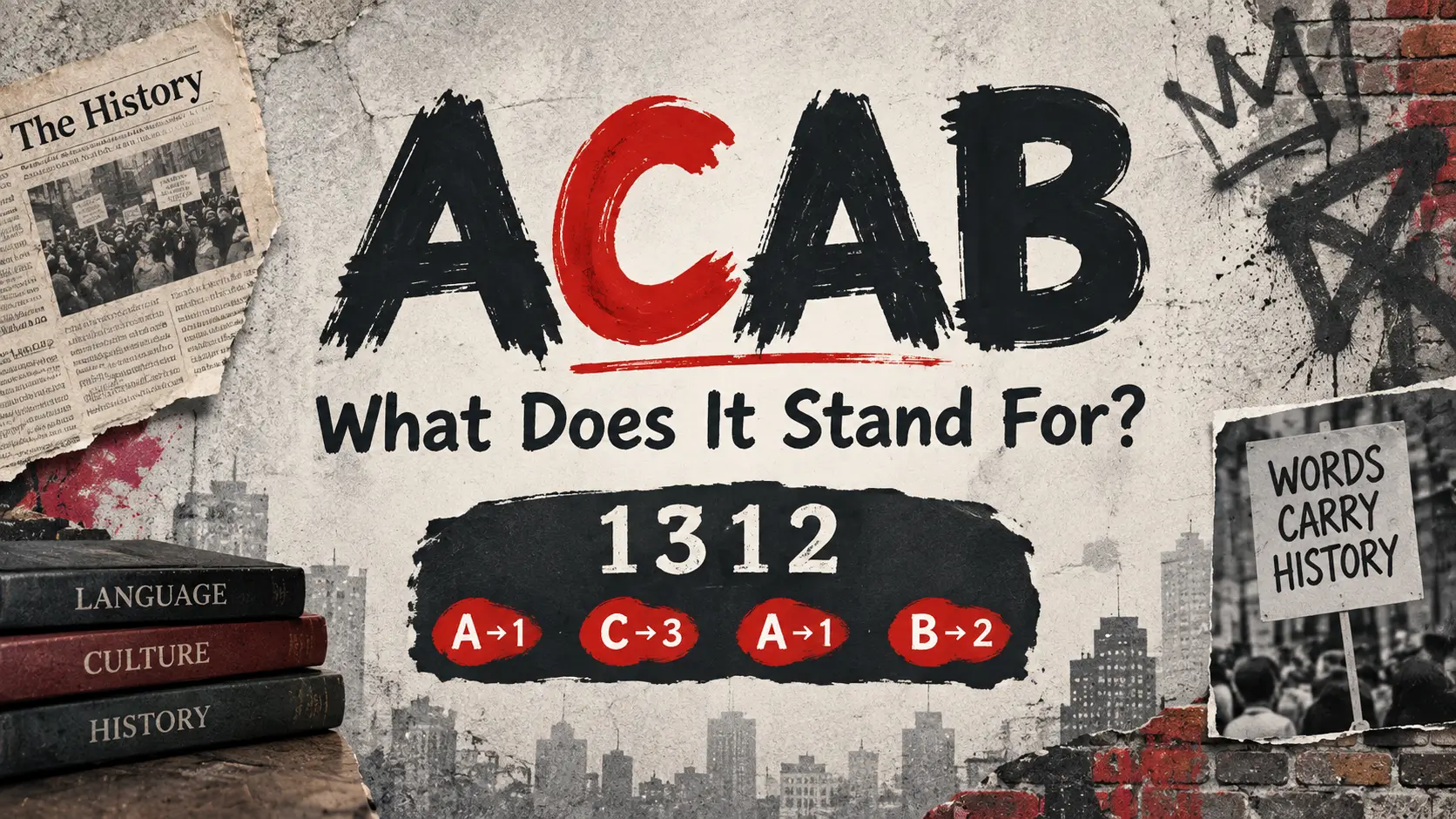
1312 is a numerical version of ACAB.
Each number corresponds to the alphabet position of one letter:
| Letter | Alphabet position |
| A | 1 |
| C | 3 |
| A | 1 |
| B | 2 |
Therefore:
A-C-A-B → 1-3-1-2 → 1312
The number may appear in graffiti, tattoos, clothing, social media profiles, and protest material.
So, when 1312 appears in a context involving police, protest, or anti-police culture, it may be a reference to ACAB.
ACAB: Acronym or Initialism?
ACAB is commonly called an acronym, but its pronunciation can vary.
Some sources give pronunciations such as “A-C-A-B”, with each letter spoken separately, while others list “ay-cab.”
For that reason, initialism is a useful linguistic description when the letters are spoken individually.
Unlike NASA, which is normally pronounced as a single word, ACAB is commonly pronounced by saying its individual letters.
How Is ACAB Pronounced?
ACAB is commonly pronounced:
“A-C-A-B”
It may also be pronounced “ay-cab.” Both pronunciations are documented in English-language reference sources.
ACAB vs. 1312
ACAB and 1312 refer to the same slogan, but they use different forms.
| Term | What it uses | Meaning |
| ACAB | Letters | All Cops Are Bastards |
| A.C.A.B. | Letters with periods | All Cops Are Bastards |
| acab | Lowercase letters | All Cops Are Bastards |
| 1312 | Numbers | Numerical form of ACAB |
The connection between ACAB and 1312 comes directly from the alphabet positions of A, C, A, and B.
Myth vs. Fact
Myth: ACAB is a new internet abbreviation.
Fact: The phrase and acronym existed long before social media. Its history is connected to British usage and later punk and protest cultures.
Myth: 1312 is an unrelated number.
Fact: In this context, 1312 represents ACAB through the alphabet positions of its four letters.
Myth: ACAB has only one use everywhere.
Fact: The anti-police slogan is the dominant modern meaning, but ACAB can also refer to unrelated names and organizations. Context matters.
How Is ACAB Used?
ACAB can appear in several forms of public and online expression.
You may encounter it in:
- Graffiti
- Protest signs
- Tattoos
- Clothing
- Music
- Social media posts
- Online comments
- Political demonstrations
Its meaning usually depends on the surrounding context. For example, ACAB beside a protest message is likely being used as an anti-police political slogan.
The term became especially visible internationally during the 2020 protests connected with police violence and racial justice.
ACAB in a Sentence
Here are examples that show how the term may appear naturally:
- “I saw ACAB written on the wall near the protest.”
- “The number 1312 appeared on his jacket.”
- “She searched for the meaning of ACAB after seeing it online.”
These examples explain how the term can appear without endorsing the political message behind it.
What Does ACAB Mean in Texting?
In a text message, ACAB usually means “All Cops Are Bastards.”
It is not normally a neutral texting abbreviation like “LOL” or “BRB.” When someone uses ACAB in a message, post, or profile, it generally carries an anti-police or protest-related meaning.
The surrounding conversation is still important because ACAB can have unrelated meanings in specialized contexts.
Is ACAB Offensive?
Yes. The phrase behind ACAB contains a strong insult directed at police officers as a group.
Some people use the slogan as a political expression against policing or perceived police misconduct. Others view it as an offensive generalization about police officers.
Understanding what the term means does not require agreeing with the message.
Why Did ACAB Become Popular?
ACAB existed for decades before becoming common online.
It became associated with several subcultures and movements, including British punk and skinhead scenes. The 1982 song “A.C.A.B.” by The 4-Skins helped give the acronym greater visibility within punk culture.
The slogan later spread through international protest culture and social media. Its visibility increased sharply during the 2020 protests following George Floyd’s death.
Frequently Asked Questions
What does ACAB stand for?
ACAB stands for “All Cops Are Bastards.” It is a derogatory anti-police slogan used in political and protest contexts.
What does 1312 mean?
1312 is a numerical representation of ACAB. The numbers correspond to the alphabet positions of A, C, A, and B.
Is ACAB an acronym or initialism?
ACAB is commonly described as an acronym, but it is also accurately described as an initialism when each letter is pronounced separately. Reference sources document both “A-C-A-B” and “ay-cab” pronunciations.
Where did ACAB originate?
The slogan is associated with Great Britain and has roots in British usage during the 20th century. Its exact origin is uncertain, so claims about one specific person or event creating it should be treated cautiously.
What does ACAB mean on social media?
On social media, ACAB usually carries the same anti-police meaning as it does in graffiti and protest settings. It may be used in posts, comments, profiles, or images expressing opposition to police or policing.
Conclusion
ACAB stands for “All Cops Are Bastards.” It is a strong anti-police slogan with roots in British usage and later connections to punk, protest, and online culture.
The number 1312 is a coded form of the same expression, based on the alphabet positions of A, C, A, and B.

Michael Bennett is an educational content writer with a focus on technical, business, medical, and everyday terminology. He researches unfamiliar abbreviations and explains their meanings in straightforward language so readers can quickly understand what a term stands for and where it is commonly used.