What Does LBS Stand For?
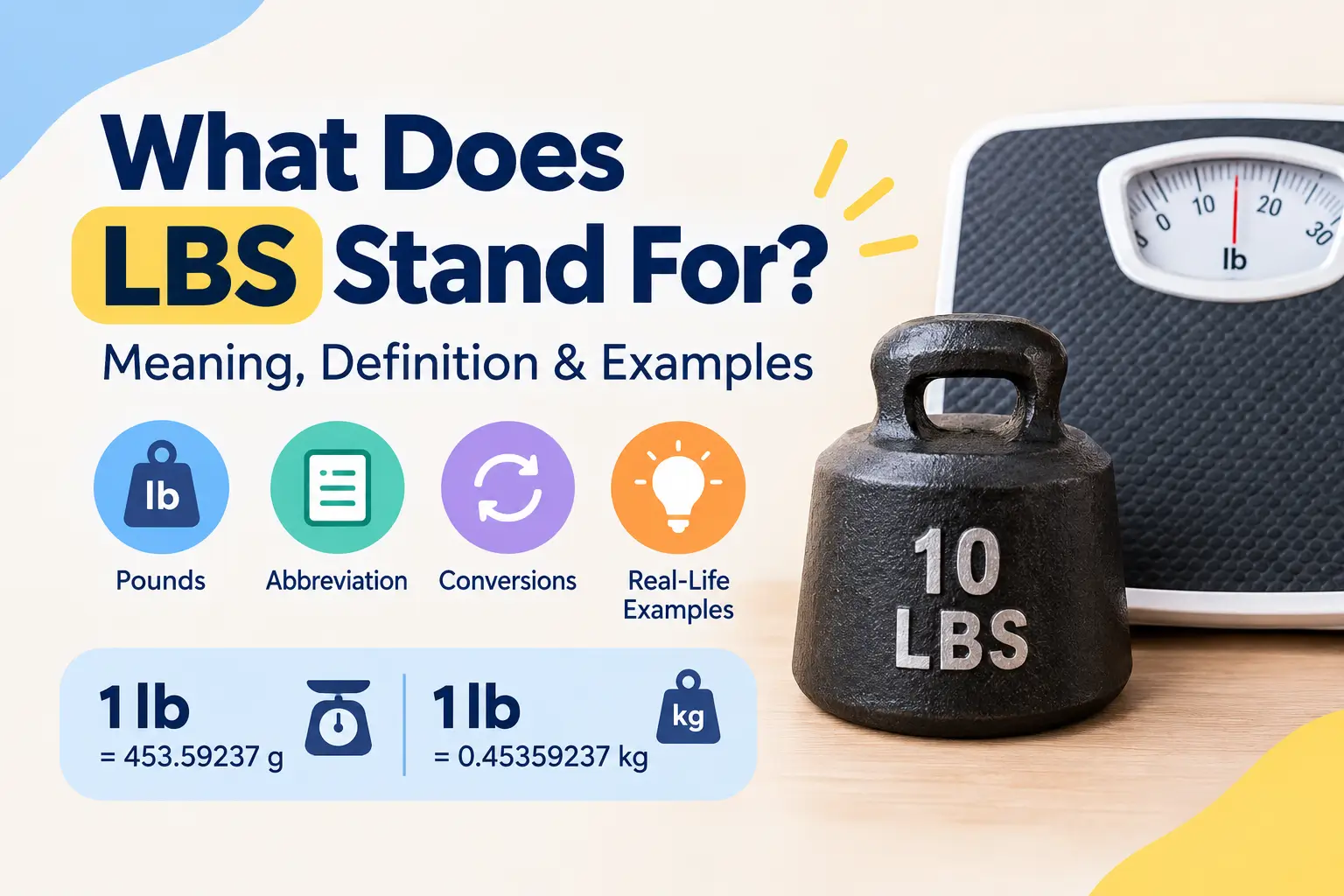
LBS stands for pounds, a unit of mass commonly used to measure weight. The singular form is usually written as lb, while lbs is commonly used for more than one pound in everyday writing.
You may see lbs on food packages, bathroom scales, shipping labels, gym equipment, recipes, and product details. For example, 10 lbs means 10 pounds.
The abbreviation can look confusing because it does not match the English spelling of “pounds.” Its history goes back to the Latin word libra, which is linked to the traditional pound unit.
Quick Reference: LBS
| Detail | Answer |
| Full form | Pounds |
| Singular | Pound |
| Common abbreviation | lb |
| Plural abbreviation | lbs |
| Type | Unit abbreviation |
| Category | Measurement |
| Exact avoirdupois value | 453.59237 grams |
| Common uses | Weight, shipping, food, fitness, products |
| Origin of lb | Latin libra |
| Pronunciation | Usually spoken as “pounds” |
NIST lists the avoirdupois pound as lb and defines one pound as exactly 453.59237 grams.
What Does LBS Stand For?
LBS stands for pounds. It is a common written abbreviation for the plural form of pound.
For example:
- 1 lb = 1 pound
- 2 lbs = 2 pounds
- 10 lbs = 10 pounds
- 50 lbs = 50 pounds
You do not need to convert lbs into pounds. They describe the same unit.
If a package says it weighs 20 lbs, it weighs 20 pounds. If a gym plate says 45 lbs, it has a stated mass of 45 pounds.
The exact unit matters when you convert it to metric measurements. One avoirdupois pound equals 453.59237 grams, or about 0.4536 kilograms.
What Is LBS?
Lbs is a written abbreviation for pounds. It is not normally treated as a separate unit.
The pound is a traditional unit of mass used in the United States and in other places where customary or imperial measurements appear. NIST includes the pound in its tables of U.S. customary units.
You can find pounds in many everyday situations. A person may give their body weight in pounds. A recipe may list an ingredient by pounds. A shipping company may list a package weight in pounds.
For example:
The box weighs 15 lbs.
This means:
The box weighs 15 pounds.
There is no difference in the measurement itself.
Where Did LBS Come From?
The abbreviation lb comes from the Latin libra, which was associated with a unit of weight and with scales or balances. Historical U.S. government material also connects the abbreviation lb for pound with the Roman libra.
This explains why the abbreviation does not begin with the letter p.
The English word pound developed through a different part of the older Latin expression connected with weight. The abbreviation kept the older libra connection instead.
Why Does LBS Have an S?
In everyday writing, people often add s to lb to show that the amount is plural.
So you may see:
- 1 lb
- 5 lbs
- 25 lbs
- 100 lbs
However, formal technical writing can use lb for both singular and plural quantities. Unit style varies by publication and context. Some style guides and technical sources prefer the unchanged abbreviation lb rather than lbs.
That means lbs is common, but it is not always the preferred technical form.
Is LBS an Acronym or an Abbreviation?
Lbs is an abbreviation, not a true acronym.
An acronym is normally formed from initial letters and is often pronounced as a word. For example, NASA comes from “National Aeronautics and Space Administration” and is pronounced as a word.
Lbs works differently. It is a shortened written form connected to the historical abbreviation lb for pound.
So the simplest classification is:
LBS → abbreviation for pounds
It is better not to describe lbs as a traditional acronym.
What Is the Difference Between LB and LBS?
The main difference is the quantity being described in everyday writing.
| Form | Common meaning | Example |
| lb | pound | 1 lb |
| lbs | pounds | 10 lbs |
| pound | Full word | 1 pound |
| pounds | Full plural word | 10 pounds |
For example:
Correct in common usage:
The package weighs 1 lb.
Also common:
The package weighs 10 lbs.
In formal scientific and technical contexts, you may instead see 10 lb, because unit symbols are often left unchanged when the quantity becomes plural.
The important point is that lb and lbs do not represent different units.
How Much Is 1 LBS?
Strictly speaking, 1 lbs is not the usual way to write one pound. The singular form is normally 1 lb.
One avoirdupois pound equals exactly:
1 lb = 453.59237 grams
That is also about:
1 lb = 0.45359237 kilograms
NIST gives the exact avoirdupois conversion as 453.59237 grams.
Here are some useful examples:
| Pounds | Kilograms |
| 1 lb | 0.4536 kg |
| 5 lbs | 2.2680 kg |
| 10 lbs | 4.5359 kg |
| 20 lbs | 9.0718 kg |
| 50 lbs | 22.6796 kg |
| 100 lbs | 45.3592 kg |
For quick estimates, many people use 2.2 pounds per kilogram. For exact work, use the full conversion factor.
LBS vs. Pounds
There is no measurement difference between lbs and pounds.
Pounds is the full word.
Lbs is a shortened written form.
For example:
This bag weighs 25 pounds.
and:
This bag weighs 25 lbs.
Both statements refer to the same amount.
The difference is only how the unit is written.
You may prefer the full word in normal sentences when clarity matters. An abbreviation is useful when space is limited, such as on labels, charts, product specifications, and tables.
LBS vs. LB
The difference between lbs and lb is mainly one of number in everyday writing.
Use lb when talking about one pound:
The package weighs 1 lb.
Use lbs when talking about several pounds:
The package weighs 8 lbs.
However, formal technical systems may use lb for both one and multiple pounds. NIST’s unit tables use lb for the pound rather than treating lbs as a separate unit symbol.
So you may encounter both:
5 lbs
and:
5 lb
The context and style guide determine which form is preferred.
Where Do You See LBS?
You can find lbs in many everyday settings.
Body Weight
People commonly use pounds to describe body weight.
For example:
He weighs 165 lbs.
This means he weighs 165 pounds.
Fitness and Gym Equipment
Gym equipment often displays weights in pounds.
Examples include:
- 10 lbs
- 25 lbs
- 45 lbs
- 100 lbs
A dumbbell marked 20 lbs is a 20-pound dumbbell.
Food and Cooking
Recipes can use pounds to describe ingredients.
For example:
Add 2 lbs of potatoes.
This means to add two pounds of potatoes.
Shipping
Shipping services may list the weight of a package in pounds.
For example:
Package weight: 12 lbs
This tells the carrier that the package has a stated weight of 12 pounds.
Product Specifications
Manufacturers may list the weight of furniture, tools, machines, bags, and other products in pounds.
For example:
Product weight: 35 lbs
The same product may also show its metric weight in kilograms.
LBS in Different Contexts
The lowercase form lbs usually points to pounds when it appears next to a number.
For example:
15 lbs
Almost always refers to 15 pounds.
The uppercase form LBS, however, can represent other terms. Acronym databases list meanings such as Location-Based Services and London Business School, among many others.
This makes context important.
Compare these examples:
The dog weighs 30 lbs.
Here, lbs clearly means pounds.
The app uses LBS to provide location information.
Here, LBS may refer to Location-Based Services.
The number and surrounding words usually make the intended meaning clear.
Common Misconceptions About LBS
Myth: LBS Is a Different Unit From Pounds
Fact: Lbs is simply a common abbreviation for pounds. It does not describe a different measurement.
Myth: LB Means Something Different From LBS
Fact: Both refer to the pound unit. In everyday writing, lb is commonly used for one pound and lbs for multiple pounds. Some technical styles use lb for both.
Myth: LBS Is Always an Acronym
Fact: When it means pounds, lbs is better described as an abbreviation. The letters come from the historical lb abbreviation linked to Latin libra.
Myth: You Need to Convert LBS to Pounds
Fact: You do not. 10 lbs already means 10 pounds. Conversion is only needed when changing pounds into another unit, such as kilograms.
How Do You Use LBS in a Sentence?
Here are some natural examples:
- The package weighs 15 lbs.
- I bought 5 lbs of rice.
- The dumbbells weigh 20 lbs each.
- The suitcase is limited to 50 lbs.
- The dog weighs about 30 lbs.
- The machine can lift 200 lbs.
In each example, lbs means pounds.
When writing for a formal or technical audience, you may want to use lb instead. Follow the style used by your publication, company, or field.
How Is LBS Pronounced?
When lbs means pounds, you normally do not pronounce the letters individually.
You simply say:
“pounds.”
For example:
25 lbs
is read aloud as:
“25 pounds.”
If LBS represents an unrelated acronym, its pronunciation depends on that acronym.
What Does LBS Mean in Text Messages?
The meaning of LBS in a text message depends on the context.
If someone writes:
I lost 10 lbs.
they almost certainly mean 10 pounds.
If someone writes LBS without a number, it could refer to another abbreviation. Several acronym databases list different meanings for LBS across technology, business, education, medicine, and other fields.
So look at the words around the abbreviation.
A number plus lbs usually points to pounds. A business, technology, or school-related conversation may point to a different meaning.
What Does LBS Mean on a Scale?
On a scale, lbs means pounds.
If a scale shows:
150 lbs
the reading means 150 pounds.
Some digital scales let you switch between lb or lbs and kg. The pound setting is useful when you want your weight displayed using the U.S. customary unit.
The measurement itself does not change when you switch between units. Only the way the value is expressed changes.
Is LBS Used in the Metric System?
No. The pound is not an SI metric unit.
The metric system uses units such as grams and kilograms. NIST lists the pound among U.S. customary units and gives its exact relationship to the kilogram.
This is why you often see both units on products.
For example:
20 lb / 9.07 kg
The two values describe the same mass using different measurement systems.
Is LBS the Same as Pounds?
Yes. When lbs refers to measurement, it means pounds.
There is no separate conversion between the two.
For example:
- 5 lbs = 5 pounds
- 25 lbs = 25 pounds
- 100 lbs = 100 pounds
The conversion only becomes necessary when changing pounds to kilograms, grams, or another unit.
Frequently Asked Questions
What does lbs stand for?
Lbs stands for pounds, the plural form of pound in common usage. It is a written abbreviation used to describe mass or weight. NIST identifies lb as the abbreviation for the pound unit.
Why is pound abbreviated as lb?
The abbreviation lb comes from the Latin word libra, which was associated with a unit of weight. Historical U.S. government material specifically connects the modern abbreviation lb with the Roman libra.
Is 1 lb the same as 1 pound?
Yes. 1 lb means 1 pound. One avoirdupois pound equals exactly 453.59237 grams.
Should I write lb or lbs?
In everyday writing, lb is commonly used for one pound and lbs for multiple pounds. In technical writing, lb may be used for both singular and plural quantities. Follow the style guide for your field.
What is the difference between lbs and kg?
Lbs refers to pounds, while kg refers to kilograms. One pound equals 0.45359237 kilograms.
Does LBS always mean pounds?
No. Context matters. LBS can represent other terms, including Location-Based Services and London Business School. When it appears after a number, however, lbs commonly refers to pounds.
Conclusion
LBS stands for pounds, the common written form of the plural measurement unit. The abbreviation comes from the historical lb form linked to the Latin word libra.
When you see 10 lbs, you can simply read it as 10 pounds. Just remember that formal technical writing may use lb for both singular and plural quantities.

Daniel Carter is an English language researcher and content writer who explains acronyms, abbreviations, and everyday terms in simple, easy-to-understand language. He focuses on helping readers understand what common letters and shortened terms mean and how they are used in real life.