
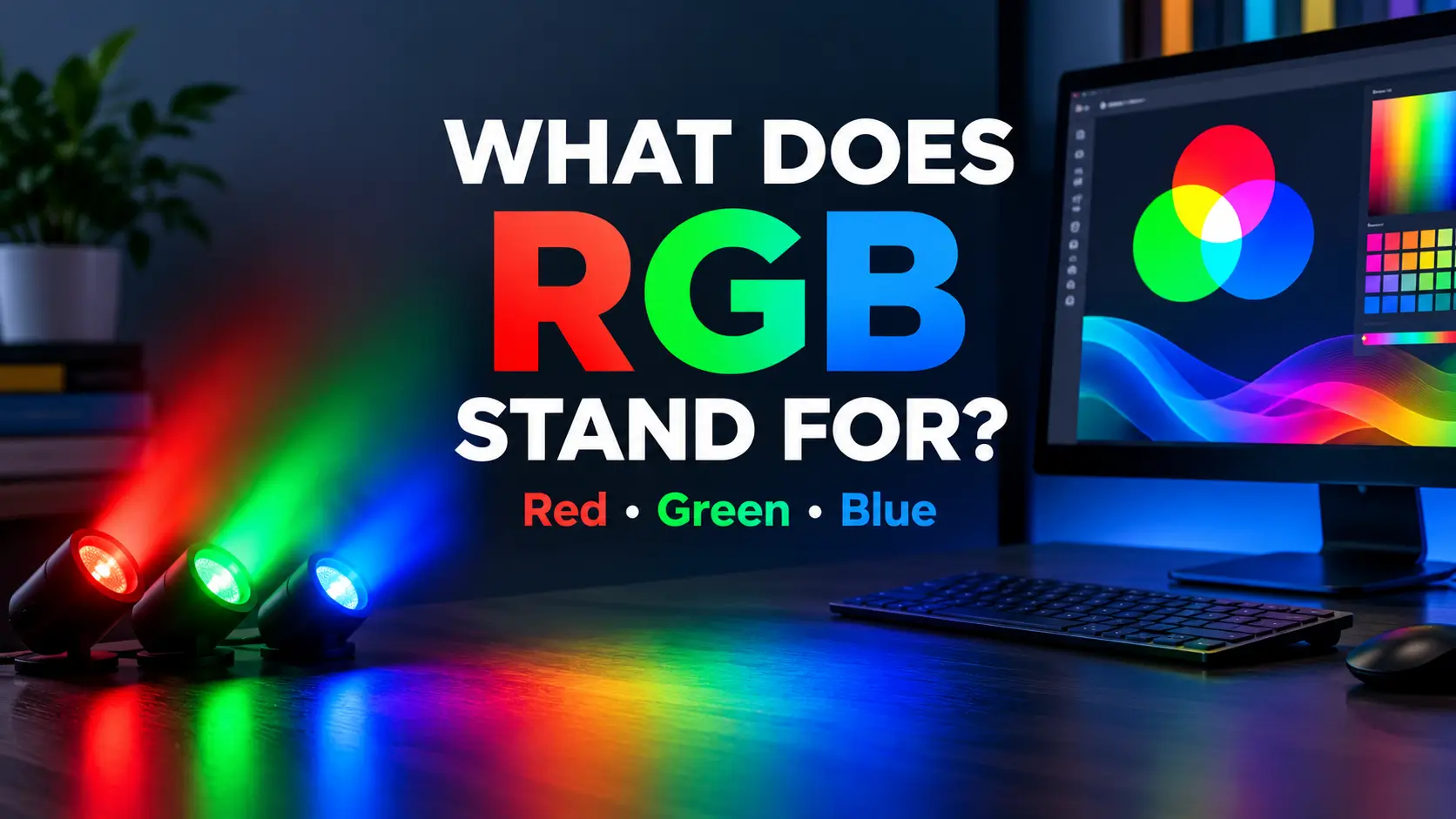
What Does RGB Stand For?
RGB stands for Red, Green, and Blue. It is a color model that uses different amounts of red, green, and blue light to create colors on digital screens.
What Does RGB Stand For?
RGB stands for Red, Green, and Blue.
The three letters describe the three color channels used in the RGB color model:
- R = Red
- G = Green
- B = Blue
RGB is an additive color model. This means colors are created by adding light from these three channels. When all three channels have their highest intensity, they produce white. When all three are set to zero, they produce black.
You will see RGB values in websites, photos, videos, computer graphics, phones, televisions, and other digital displays.
What Is RGB?
RGB is a way to describe colors by using three separate color components: red, green, and blue.
Each component has a value that controls its intensity. In a common 8-bit RGB system, each value can range from 0 to 255. For example, rgb(255, 0, 0) represents red because the red channel is at full intensity while green and blue are at zero.
Different combinations create different colors.
For example:
| RGB Value | Color |
| rgb(255, 0, 0) | Red |
| rgb(0, 255, 0) | Green |
| rgb(0, 0, 255) | Blue |
| rgb(255, 255, 0) | Yellow |
| rgb(0, 255, 255) | Cyan |
| rgb(255, 0, 255) | Magenta |
| rgb(255, 255, 255) | White |
| rgb(0, 0, 0) | Black |
These examples show the basic idea of additive color. More light from each channel changes the final color.
How Does RGB Work?
RGB works by combining different levels of red, green, and blue light.
Think of each color as having its own control. Raising the red value adds more red light. Increasing the green level introduces more green light. Adjusting blue higher will yield more blue light.
For an 8-bit RGB value, each channel can use 256 possible values, from 0 through 255. Three channels together allow 16,777,216 possible combinations.
For example:
- 0, 0, 0 = black
- 255, 0, 0 = red
- 0, 255, 0 = green
- 0, 0, 255 = blue
- 255, 255, 255 = white
The exact colors you see can still depend on the color space and display device. RGB is a model, while a color space defines how those RGB values correspond to actual colors.
Why Is RGB Called Additive?
RGB is called additive because it creates color by adding light.
When no RGB light is present, the result is black. As more light is added, the result becomes brighter.
When red and green light are combined at full intensity, the result is yellow. Red and blue produce magenta, while green and blue produce cyan. Full red, green, and blue together produce white.
This is different from printing, where inks absorb light rather than adding emitted light.
Where Is RGB Used?
RGB is mainly associated with digital color and light-based displays.
You can find RGB in:
- Computer monitors
- Smartphones
- Televisions
- Tablets
- Digital cameras
- Websites
- Video content
- Computer graphics
- Mobile apps
- Digital artwork
- CSS and web design
- RGB lighting products
For the web, sRGB is a major RGB color space. Modern CSS also supports RGB color values through functions such as rgb().
RGB is also used in computer hardware. For example, some keyboards, memory modules, fans, and other PC components use RGB LEDs for customizable lighting. Kingston describes RGB LEDs in computer memory as lighting components used to create lighting patterns.
What Do RGB Values Mean?
RGB values tell a device how much of each color channel to use.
In the common 0–255 format:
- 0 means no intensity for that channel.
- 255 means maximum intensity for that channel.
- Values between 0 and 255 represent different intensity levels.
For example, rgb(255, 100, 0) contains a lot of red, some green, and no blue.
Changing one number can change the final color.
In CSS, RGB can be written using the rgb() function. Modern CSS also supports percentage values and an optional alpha value for transparency.
Example:
rgb(31 120 50)
This tells the browser to create a color using red, green, and blue components.
What Is the Difference Between RGB and sRGB?
RGB is the general color model. sRGB is a specific RGB color space.
This difference is important because RGB values do not describe a complete color by themselves. The color space tells you how those values should be interpreted.
For example, sRGB uses red, green, and blue components to define colors for common digital use. MDN notes that the underlying color space for an RGB value on the web is generally sRGB.
Other RGB color spaces also exist. These include Adobe RGB and ProPhoto RGB, which have different color characteristics and ranges.
So, saying “RGB” does not always mean one exact color space.
Is RGB an Acronym or an Initialism?
RGB is best described as an initialism because its letters are normally spoken individually: R-G-B.
You usually say:
“R-G-B”
rather than pronouncing it as one word.
An acronym is commonly pronounced as a word, such as NASA. RGB follows the initialism pattern because each letter is spoken separately.
In everyday use, however, people often call RGB an abbreviation or acronym. Dictionaries and technical references may use different labels, but the full form remains Red, Green, and Blue.
How Is RGB Pronounced?
RGB is pronounced by saying each letter separately:
R-G-B
In American English, the Cambridge Dictionary gives the pronunciation as approximately “ar-jee-bee.”
It is not normally pronounced as a single word.
RGB vs. CMYK
These two distinct color models serve very different purposes.
| RGB | CMYK |
| Red, Green, Blue | Cyan, Magenta, Yellow, Key/Black |
| Additive color model | Subtractive color model |
| Uses light | Uses ink or pigment |
| Common for digital displays | Common for print |
| Starts with black when no light is present | Starts with a light or white surface |
RGB adds light to create colors. CMYK uses inks that absorb parts of light reflected from a surface.
This is why a color that looks bright on a monitor may look different after printing. The two systems use different methods to produce color.
For web content, sRGB is widely used. For printed work, the appropriate color setup depends on the printer, inks, paper, and production process.
RGB vs. Hex Colors
RGB and hexadecimal colors are different ways to represent colors digitally.
For example, a red color can be written as:
RGB: rgb(255, 0, 0)
Hex: #FF0000
Both can represent the same sRGB color.
A hex color uses six hexadecimal characters. The first two describe red, the next two describe green, and the last two describe blue.
For example:
#FF0000
means full red, zero green, and zero blue.
Web developers commonly use both RGB and hex values in CSS. Modern CSS also supports several other ways to define color.
Is RGB Used in Web Design?
Yes. RGB is widely used in web design and development.
CSS provides the rgb() function for defining colors in the sRGB color space. You can use it for backgrounds, text, borders, buttons, gradients, and many other design elements.
For example:
.button {
background: rgb(30 100 220);
}
This tells the browser to use an RGB color for the button background.
Web designers may also use hex, HSL, HWB, and other color formats. The best choice often depends on the design tool and coding workflow.
Why Do RGB Colors Look Different on Different Screens?
RGB values do not guarantee that every screen will show exactly the same visual color.
Displays can differ in their color capabilities, calibration, brightness, and supported color spaces. The same RGB numbers can therefore look slightly different across devices.
Color management helps reduce these differences.
For web content, sRGB is important because it provides a common color space for digital content. W3C accessibility guidance also uses sRGB when explaining color and relative luminance calculations.
Myth vs. Fact
Myth: RGB means every digital color is exactly the same everywhere.
Fact: RGB describes color components, but the color space and display can affect how the color appears.
Myth: RGB and sRGB mean exactly the same thing.
Fact: RGB is a color model, while sRGB is a specific RGB color space used widely on the web.
Myth: RGB is only used for computer monitors.
Fact: RGB is used across many digital technologies, including phones, televisions, cameras, websites, and digital graphics.
RGB Used in a Sentence
Here are a few natural examples of how you might see RGB used:
- The designer changed the RGB values to match the brand color.
- This monitor supports a wide range of RGB colors.
- The website uses an RGB color value for its blue buttons.
These examples use RGB in its common digital-color sense.
What Does RGB Mean in CSS?
In CSS, RGB refers to the red, green, and blue components used to define a color.
The rgb() function lets developers specify these components directly. Modern CSS supports values such as:
color: rgb(255 0 0);
It also supports an optional alpha component for transparency:
color: rgb(255 0 0 / 50%);
The CSS specification defines rgb() as a way to express a color in the sRGB color space using red, green, and blue components.
What Does RGB Mean in Gaming?
In gaming, RGB often refers to customizable colored lighting on gaming hardware.
You may see RGB lighting on:
- Gaming keyboards
- Gaming mice
- PC cases
- Fans
- RAM
- Motherboards
- Headsets
- Controllers
The lighting can often be controlled with software. Users may choose a single color, cycling colors, or animated lighting effects.
In this context, RGB still means Red, Green, and Blue. The term describes the color system used to create the lighting effects.
What Does RGB Mean in Photography?
In photography, RGB describes the three color channels used to represent an image.
A digital image can store separate red, green, and blue information for its pixels. The combination of those channels creates the colors you see.
Many image-editing programs allow photographers to work with RGB color spaces. The exact color space matters because different spaces can represent different ranges of colors.
For web images, sRGB is especially common because it is widely supported across browsers and devices.
What Does RGB Mean in a Color Code?
When someone asks for the “RGB color code,” they usually want three numerical values.
For example:
RGB(0, 128, 255)
Here:
- Red = 0
- Green = 128
- Blue = 255
The numbers describe the strength of each channel.
A color picker can show these values alongside other formats such as hex and HSL. This makes it easy to move a color between design tools and websites.
Is RGB the Same as Red, Green, and Blue?
Yes. RGB is the standard abbreviation or initialism for Red, Green, and Blue.
The letters are simply the first letters of the three color names.
RGB does not stand for “red, gray, and blue” or another combination. The standard meaning in color and computing is Red, Green, and Blue.
FAQ About RGB
What does RGB stand for in computers?
RGB stands for Red, Green, and Blue. Computers use RGB-based color systems to represent and display many digital colors.
What does RGB stand for in LED lights?
RGB still stands for Red, Green, and Blue. RGB LED systems combine these three light colors at different intensities to create different lighting colors.
What are the three colors in RGB?
The three RGB channels are red, green, and blue. Each channel can have a different intensity, allowing the system to represent many colors.
Is RGB better than CMYK?
RGB and CMYK serve different purposes. RGB is designed around light and is widely used for digital displays, while CMYK is based on inks and is widely used for print.
What is the RGB value for white?
In the common 8-bit RGB system, white is RGB(255, 255, 255). All three color channels are set to their maximum value.
Conclusion
RGB stands for Red, Green, and Blue. It is an additive color model that creates colors by combining different amounts of red, green, and blue light.
You will commonly encounter RGB in screens, websites, photos, digital graphics, CSS, and LED lighting. For web work, RGB is often used through the sRGB color space, which provides a common way to represent digital colors.

Emily Morgan is a language and communication writer who specializes in explaining abbreviations, internet terms, workplace language, and common expressions. Her writing turns unfamiliar terms into clear definitions that are easy for students, professionals, and everyday readers to understand.