What Does CDL Stand For?
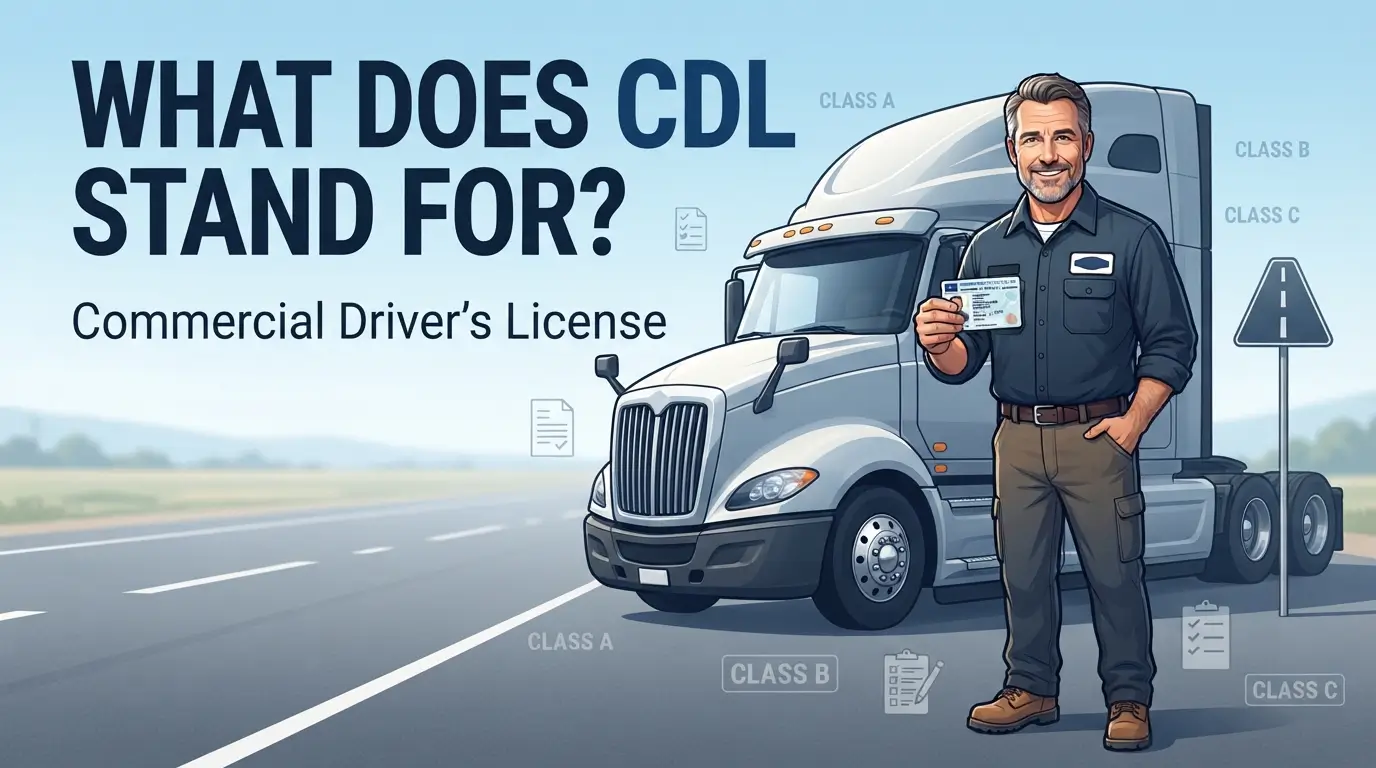
CDL stands for Commercial Driver’s License.
A CDL allows qualified drivers to operate certain large or specialized commercial vehicles. These can include heavy trucks, buses, and vehicles carrying hazardous materials.
The exact requirements depend on the vehicle, license class, endorsements, and state rules.
What Is a CDL?
A Commercial Driver’s License is a type of driver’s license used for commercial driving in the United States.
The Federal Motor Carrier Safety Administration sets federal minimum standards. However, state governments issue CDLs and handle many application and licensing details.
A CDL requires more knowledge and driving skills than a regular driver’s license. CDL holders are also held to higher safety standards when driving on public roads.
CDL at a Glance
| Detail | Information |
| Full form | Commercial Driver’s License |
| Short form | CDL |
| Category | Transportation / licensing |
| Main use | Commercial motor vehicle operation |
| Issued by | State governments |
| Federal agency | FMCSA |
| Main classes | Class A, Class B, Class C |
| Related permit | Commercial Learner’s Permit (CLP) |
What Are the Different CDL Classes?
There are three main CDL classes: Class A, Class B, and Class C. The class determines the type of commercial vehicle a driver can operate.
Class A CDL
A Class A CDL generally covers combinations of vehicles with a gross combined weight rating of at least 26,001 pounds when the vehicle being towed exceeds 10,000 pounds.
This class is commonly associated with combination vehicles such as tractor-trailers.
Class B CDL
A Class B CDL generally covers a single vehicle with a gross vehicle weight rating of at least 26,001 pounds. It can also cover such a vehicle towing another vehicle that weighs 10,000 pounds or less.
Heavy straight trucks are one example of vehicles that may fall into this class.
Class C CDL
A Class C CDL covers certain vehicles that do not meet the Class A or Class B definitions.
It can include vehicles designed to carry 16 or more passengers, including the driver. It can also apply to vehicles carrying federally regulated hazardous materials.
What Is a CDL Endorsement?
A CDL endorsement adds permission to operate certain specialized vehicles or perform specific types of commercial driving.
Examples include endorsements for:
- Passenger vehicles (P)
- School buses (S)
- Hazardous materials (H)
- Tank vehicles (N)
- Double or triple trailers (T)
The endorsement you need depends on the type of vehicle and work involved.
How Do You Get a CDL?
The process varies by state, but the federal framework includes several major steps.
1. Get a Commercial Learner’s Permit
A Commercial Learner’s Permit (CLP) allows you to practice driving a commercial vehicle on public roads with a qualified CDL holder.
Your state may also require documents related to identity, residency, medical qualifications, and driving history.
2. Complete Required Training
Some new CDL applicants must complete Entry-Level Driver Training (ELDT) before taking the required test.
Federal ELDT rules apply to first-time Class A and Class B applicants and certain applicants seeking passenger, school bus, or hazardous-material endorsements.
3. Pass the CDL Tests
Depending on your license and endorsements, you may need knowledge and skills tests.
The CDL skills test includes:
- Vehicle inspection
- Basic vehicle controls
- Road test
FMCSA states that applicants must complete the applicable requirements before taking the CDL skills test.
4. Receive Your CDL
After meeting the required testing and state requirements, your state can issue the CDL.
FMCSA does not issue the actual CDL. State licensing agencies issue the licenses under federal standards.
What Is the Difference Between a CDL and a Regular License?
A regular driver’s license is generally used for personal vehicles.
A CDL is designed for certain commercial motor vehicles that require additional knowledge and skills.
For example, a person driving a standard passenger car normally does not need a CDL. Someone operating a qualifying heavy commercial truck may need one.
The exact requirement depends on the vehicle and how it is being used.
Is CDL an Acronym or an Initialism?
CDL is an initialism.
It is normally pronounced by saying each letter:
C-D-L
This differs from an acronym such as NASA, which is commonly pronounced as a word.
CDL vs. CLP: What Is the Difference?
CDL means Commercial Driver’s License.
CLP means Commercial Learner’s Permit.
A CLP is generally used while preparing to obtain a CDL. It allows eligible drivers to practice operating commercial vehicles under the applicable rules.
So, a CLP is not the same thing as a full CDL.
Myth vs. Fact
| Myth | Fact |
| Everyone who drives a truck needs a CDL. | CDL requirements depend on the vehicle and applicable rules. |
| FMCSA issues every CDL. | State governments issue CDLs. |
| One CDL class covers every commercial vehicle. | There are Class A, B, and C CDLs, plus specialized endorsements. |
What Does CDL Mean in Other Contexts?
Commercial Driver’s License is the dominant meaning of CDL in U.S. transportation.
However, CDL can have other meanings in specialized fields. For example, aviation uses Configuration Deviation List, while other technical fields use CDL for different terms.
The correct meaning depends on the context.
For questions about driving, trucking, buses, or commercial transportation, Commercial Driver’s License is the relevant meaning.
Current CDL Requirements and Training
Federal CDL rules continue to include training and testing requirements for certain applicants.
The FMCSA’s current guidance states that first-time Class A and Class B applicants generally fall under the Entry-Level Driver Training rules. Certain first-time endorsements also require applicable training.
As of 2026, FMCSA also maintains a Training Provider Registry where drivers can find registered training providers for applicable CDL training.
Because states can add requirements, applicants should check their state’s CDL manual before applying.
How Is CDL Pronounced?
CDL is pronounced by saying the three letters separately:
“C-D-L”
It is not normally pronounced as one word.
Used in a Sentence
Here are a few natural examples:
- She is studying for her CDL test.
- He needs a Class A CDL for his new trucking job.
- The company requires drivers to have the proper CDL endorsement.
FAQ
What does CDL stand for in trucking?
In trucking, CDL stands for Commercial Driver’s License. It is required for drivers operating commercial motor vehicles that meet applicable federal or state requirements.
What does CDL stand for in driving?
In driving, CDL usually means Commercial Driver’s License. It is different from a standard driver’s license and involves additional requirements for qualifying commercial vehicles.
What is the difference between CDL and CLP?
A CDL is the commercial driver’s license itself. A CLP, or Commercial Learner’s Permit, allows an eligible person to practice commercial driving before obtaining the CDL.
How long must you have a CLP before taking the CDL skills test?
Under the federal framework described by FMCSA, applicants generally must hold the CLP for 14 days before taking the CDL skills test. Other state requirements may also apply.
Do all CDL drivers need the same training?
No. Training depends on the CDL class and endorsements being sought. For example, different requirements can apply to Class A, Class B, passenger, school bus, and hazardous-material applicants.
Conclusion
CDL stands for Commercial Driver’s License. It is used for certain commercial motor vehicles and comes in Class A, Class B, and Class C categories, with additional endorsements for specialized driving.

Michael Bennett is an educational content writer with a focus on technical, business, medical, and everyday terminology. He researches unfamiliar abbreviations and explains their meanings in straightforward language so readers can quickly understand what a term stands for and where it is commonly used.