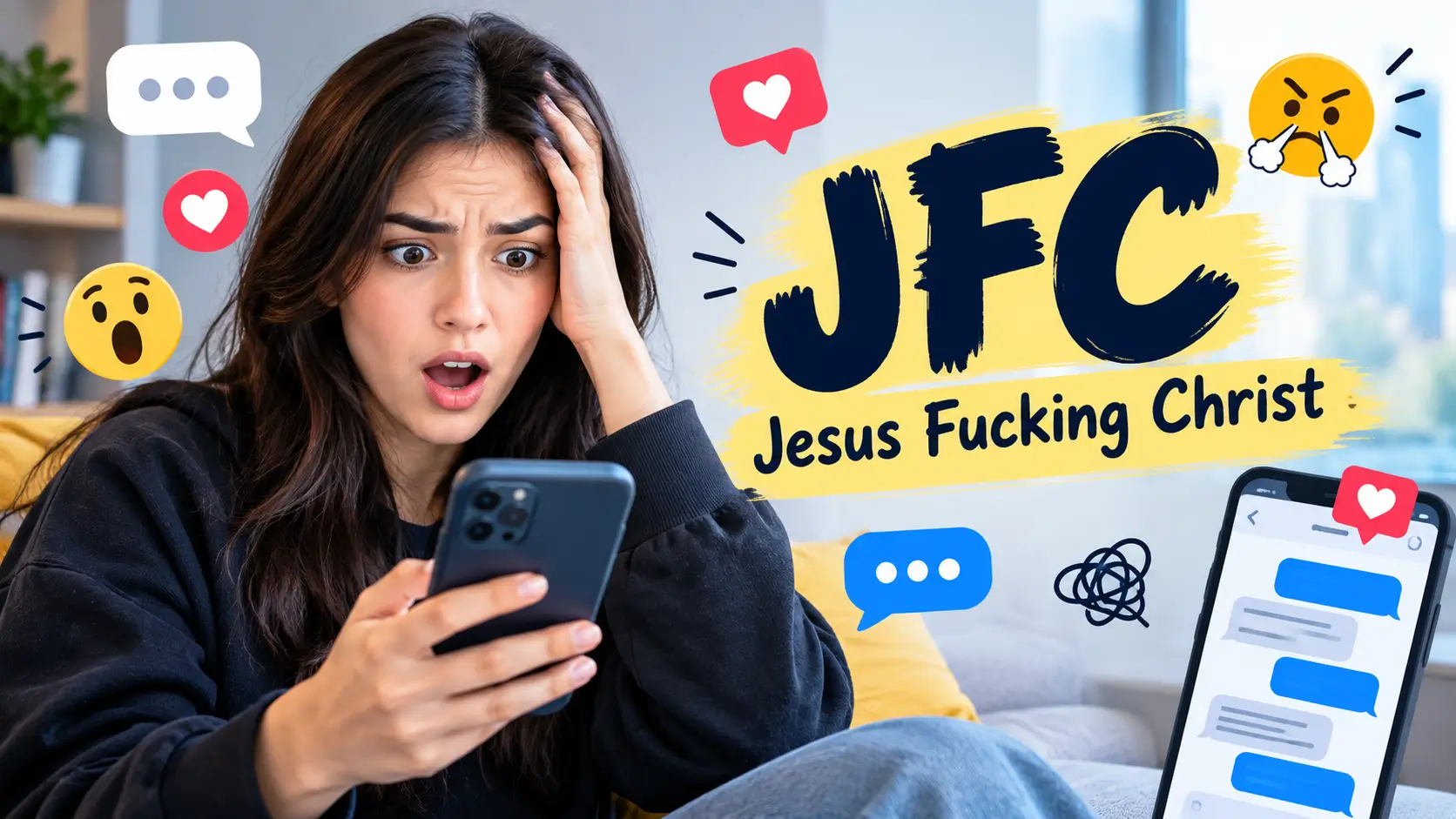
What Does JFC Stand For? Meaning, Texting & Slang Explained
JFC stands for “Jesus fucking Christ.” It is a vulgar slang initialism used to show strong surprise, frustration, annoyance, disbelief, or shock.
You may see JFC in text messages, social media comments, online chats, forums, and other informal conversations. The exact feeling depends on the situation.
For example:
“JFC, that was expensive!”
Here, JFC shows strong surprise or frustration about the price.
Quick Reference: JFC Meaning
| Detail | Answer |
| Full form | Jesus fucking Christ |
| Type | Slang initialism |
| Main use | Strong emotional reaction |
| Common emotions | Shock, frustration, annoyance, disbelief, surprise |
| Pronunciation | “Jay-eff-see” |
| Common setting | Texting, social media, online chats |
| Formality | Very informal |
| Profanity | Yes |
| Other meanings | Just For Clarification; Java Foundation Classes; Joint Force Commander |
The slang meaning is the dominant use in casual online communication. Dictionary.com describes JFC as a vulgar slang initialism, while Collins classifies it as a taboo expression used in texts and social media.
What Does JFC Stand For?
JFC stands for “Jesus fucking Christ.”
People use it as an emotional exclamation. It can show that someone is shocked, angry, frustrated, surprised, or unable to believe something.
For example:
“JFC, you scared me!”
The person is showing a strong reaction to being scared. They are not usually making a literal statement about Jesus Christ.
The phrase is considered vulgar and potentially offensive, so JFC is mainly used in casual settings. Collins specifically describes the expression as taboo.
What Does JFC Mean in Texting?
In texting, JFC usually expresses a strong emotional reaction.
The exact meaning can change with the situation.
JFC for Shock
Someone may use JFC after seeing something unexpected.
“JFC, that car nearly hit us.”
Here, JFC expresses shock or fear.
JFC for Frustration
It can also show that someone is very annoyed.
“JFC, this computer keeps freezing.”
The writer is frustrated with the situation.
JFC for Disbelief
In JFC can show that someone finds something hard to believe.
“JFC, you paid $500 for that?”
The phrase adds strong emotion to the question.
JFC for Surprise
Someone may also use JFC when something happens suddenly.
“JFC, you’re already here?”
In this case, the person is surprised by someone’s arrival.
JFC for Amazement
Context can also make JFC sound like strong amazement.
“JFC, that view is beautiful.”
The expression adds emotional intensity to the statement.
So, JFC does not always mean anger. The surrounding words and situation help explain the intended emotion.
What Do the Letters in JFC Mean?
The letters in JFC come from the three words in the full expression:
- J = Jesus
- F = fucking
- C = Christ
JFC is normally read as individual letters: “jay-eff-see.” It is therefore better described as an initialism rather than an acronym pronounced as one word.
Is JFC an Acronym or Initialism?
JFC is an initialism.
An initialism is formed from the first letters of a group of words, with each letter usually pronounced separately.
For example:
- JFC → “jay-eff-see”
- FBI → “eff-bee-eye”
- CEO → “see-ee-oh”
A traditional acronym is usually pronounced as a word.
For example:
- NASA → “nassa”
- NATO → “nay-toe”
Because JFC is normally spoken letter by letter, initialism is the more precise linguistic term.
Is JFC a Bad Word?
JFC contains profanity, so it can be considered offensive or inappropriate in many settings.
It is common in informal online communication, but that does not make it suitable for every audience.
For example, using JFC with close friends may be accepted. Using it in a formal email, job application, school assignment, or professional document may be inappropriate.
Collins lists JFC as a taboo expression, while Dictionary.com describes it as vulgar slang.
If you want a cleaner alternative, you could use:
- Wow
- Oh my God
- Seriously?
- What the heck?
- No way
- I can’t believe it
- That’s unbelievable
The best replacement depends on the emotion you want to express.
Is JFC Offensive?
It can be offensive because it combines a religious reference with profanity.
Some people may use JFC casually without intending to insult anyone. Others may consider the phrase disrespectful because it refers to Jesus Christ in a profane expression.
This means the audience matters.
A casual online conversation between friends may have a different tone from a workplace email or public post.
When you are unsure about your audience, a non-profane expression is safer.
How Is JFC Pronounced?
JFC is pronounced “jay-eff-see.”
The letters are normally said separately rather than as one word.
For example:
“I saw JFC in the comment.”
You would normally say the letters individually.
The full phrase is also sometimes shortened in writing as “Jesus f*ing Christ”** or softened as “Jesus freaking Christ.” Some dictionaries and language references describe these variations, although the original slang expression contains profanity.
How Is JFC Used in a Sentence?
Here are some natural examples of JFC in casual communication.
Example 1: Frustration
“JFC, why is this taking so long?”
The speaker is very frustrated.
Example 2: Shock
“JFC, that was close.”
The speaker is reacting to a dangerous or unexpected event.
Example 3: Disbelief
“JFC, you actually bought it?”
The speaker cannot believe what happened.
Example 4: Surprise
“JFC, I didn’t expect to see you here.”
The speaker is strongly surprised.
Example 5: Amazement
“JFC, look at the size of that house.”
The expression adds strong emphasis to the speaker’s reaction.
Where Do People Use JFC?
JFC is mainly found in informal digital communication.
Common places include:
- Text messages
- Group chats
- Social media
- Online forums
- Gaming chats
- Comment sections
- Casual messages between friends
Collins specifically notes its use in social media and text messages.
You are less likely to see it in formal writing because it contains profanity.
Where Should You Avoid Using JFC?
It is generally better to avoid JFC in formal or sensitive communication.
For example, be careful with it in:
- Business emails
- Job applications
- School assignments
- Academic papers
- Customer service messages
- Official documents
- Public statements
- Professional presentations
The issue is not that everyone will misunderstand it. Most people familiar with internet slang will understand it. The issue is tone and appropriateness.
Where Did JFC Come From?
The exact origin of the initialism JFC is unclear. Dictionary.com notes that the initialism appeared in online forums by at least the early 1990s. The underlying profane expression is much older and has been recorded as an exclamation since at least the 1920s.
The abbreviation became useful because online communication favors short forms.
Instead of typing the entire expression, a person can type three letters:
Jesus fucking Christ → JFC
This keeps the message short while still communicating a strong emotional reaction.
There is also an older related expression, “Jesus H. Christ,” which Dictionary.com traces to at least the late 19th century.
Does JFC Have Other Meanings?
Yes. JFC can have different meanings outside internet slang.
The surrounding context matters.
| JFC meaning | Context |
| Jesus fucking Christ | Slang and texting |
| Just For Clarification | Informal written communication |
| Java Foundation Classes | Java programming |
| Joint Force Commander | Military |
| James Fenimore Cooper | Person/name reference |
Abbreviations.com lists several non-slang expansions, including Java Foundation Classes and Joint Force Commander.
However, if you see JFC in a casual text or social media comment, the slang meaning is usually the relevant one.
JFC vs. WTF
JFC and WTF can both express strong emotions, but they are not identical.
| JFC | WTF |
| Jesus fucking Christ | What the fuck |
| Often shows shock or frustration | Often shows confusion, shock, or disbelief |
| Uses a religious reference | Does not use a religious name |
| Very informal | Very informal |
| Contains profanity | Contains profanity |
For example:
“JFC, that was expensive!”
This strongly emphasizes the speaker’s reaction.
“WTF is going on?”
This focuses more directly on confusion or disbelief.
The two expressions can overlap, but context determines their exact tone.
JFC vs. OMG
OMG means “Oh my God.”
Both JFC and OMG can express surprise, shock, or amazement. However, JFC is generally more vulgar because it contains an explicit swear word. Dictionary.com classifies JFC as vulgar slang.
Compare:
“OMG, that’s huge!”
This is informal but less aggressive.
“JFC, that’s huge!”
This carries a much stronger and more profane reaction.
Myth vs. Fact
Myth: JFC always means anger.
Fact: JFC can express anger, but it can also show shock, surprise, frustration, disbelief, or amazement. The context determines the emotion.
Myth: JFC is always a literal religious statement.
Fact: In texting and online slang, JFC normally functions as an emotional exclamation rather than a literal religious statement.
Myth: JFC always means “Just For Clarification.”
Fact: “Just For Clarification” is listed as another possible meaning, but the slang expression is the dominant meaning in casual internet communication.
Can JFC Mean “Just For Clarification”?
Yes, JFC can sometimes mean “Just For Clarification.”
This meaning appears in some written communication. However, it is much less recognizable than the slang meaning.
For example:
“JFC, are we meeting at 3 or 4?”
If someone intends “Just For Clarification,” the context should make that clear.
The problem is that many readers will first understand JFC as “Jesus fucking Christ.” A 2026 discussion published by Yahoo News Malaysia highlighted this exact potential misunderstanding.
For professional writing, “Just for clarification” is usually clearer than abbreviating it as JFC.
What Does JFC Mean on Social Media?
On social media, JFC usually expresses a strong reaction to something someone has posted.
It can react to:
- A surprising photo
- Bad news
- A shocking video
- An expensive purchase
- A frustrating event
- A funny situation
- Something unbelievable
For example:
“JFC, this video is wild.”
The writer is showing a strong emotional reaction to the video.
Because social media often uses informal language, abbreviations such as JFC can communicate emotion quickly.
Is JFC the Same as “Jesus Christ”?
Not exactly.
“Jesus Christ” can be used in several ways, including religious or non-religious expressions.
“JFC” specifically refers to the profane expression “Jesus fucking Christ.”
The extra word adds strong emphasis and makes the expression more vulgar.
That is why JFC usually carries a stronger emotional tone than simply writing “Jesus Christ.”
Frequently Asked Questions
What does JFC stand for in texting?
JFC usually stands for “Jesus fucking Christ” in texting. It is a vulgar initialism used to express strong emotions such as shock, frustration, disbelief, or surprise.
What does JFC mean on Snapchat?
On Snapchat, JFC normally has the same slang meaning: “Jesus fucking Christ.” It is used as a quick reaction to something surprising, frustrating, funny, or unbelievable.
What does JFC mean on TikTok?
On TikTok, JFC is generally used as an informal reaction. Someone may comment JFC when a video is shocking, surprising, frustrating, or extremely impressive.
Is JFC rude?
Yes, JFC can be considered rude or offensive. It contains profanity and uses a religious reference, so it is not suitable for every audience.
What is a polite alternative to JFC?
You can replace JFC with “wow,” “oh my gosh,” “seriously,” “no way,” “what the heck,” or “I can’t believe it.” The best choice depends on the emotion and situation.
Conclusion
JFC stands for “Jesus fucking Christ” and is mainly used as a strong slang reaction. It can express shock, frustration, disbelief, annoyance, surprise, or amazement.
Because JFC contains profanity, use it mainly in casual settings. If the audience or situation is formal, a cleaner expression such as “wow,” “seriously,” or “I can’t believe it” is clearer and safer.

Daniel Carter is an English language researcher and content writer who explains acronyms, abbreviations, and everyday terms in simple, easy-to-understand language. He focuses on helping readers understand what common letters and shortened terms mean and how they are used in real life.